
Random Deals
The Practice app supports two ways of dealing random hands. Each one is suited to a different kind of practice. You can switch between them at any time in Settings.
Probabilistic Distribution
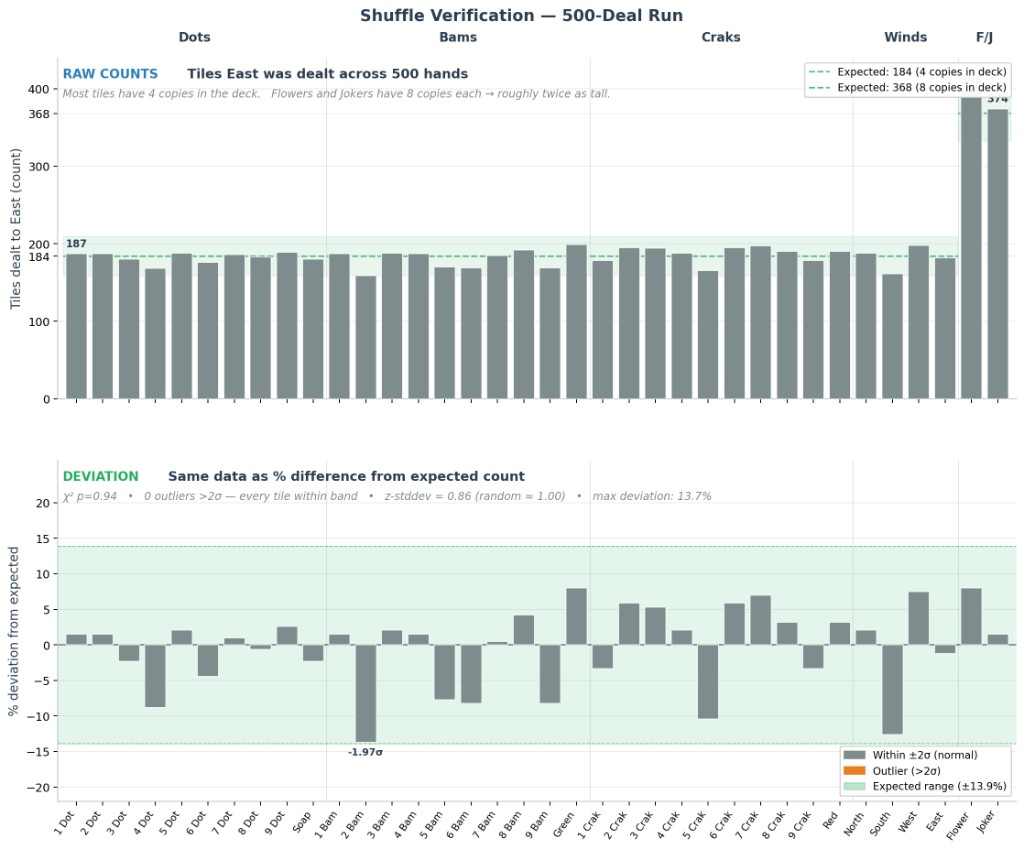
The app deals random tiles and uses every hand as it shows up. Hands that are easier to make naturally appear at the top of the suggested list more often, and harder hands less often.
- Mirrors what you'll actually see at a real table.
- Best for tournament-style and game-realistic practice.
- On by default — no setup needed.
See the comparison chart below for how this stacks up against Random Uniform Distribution.
Random Uniform Distribution
The app deals random tiles, then checks which hands those tiles match. If you've already practiced a matched hand recently, the app redeals and tries again — searching for tiles that fit a hand you haven't seen yet. Once most of the card has been covered, the cycle resets and starts over.
- Best for learning the full card
- Most hands get practice before any one repeats
- Turn it on in Settings → Advanced → Random Uniform Distribution.
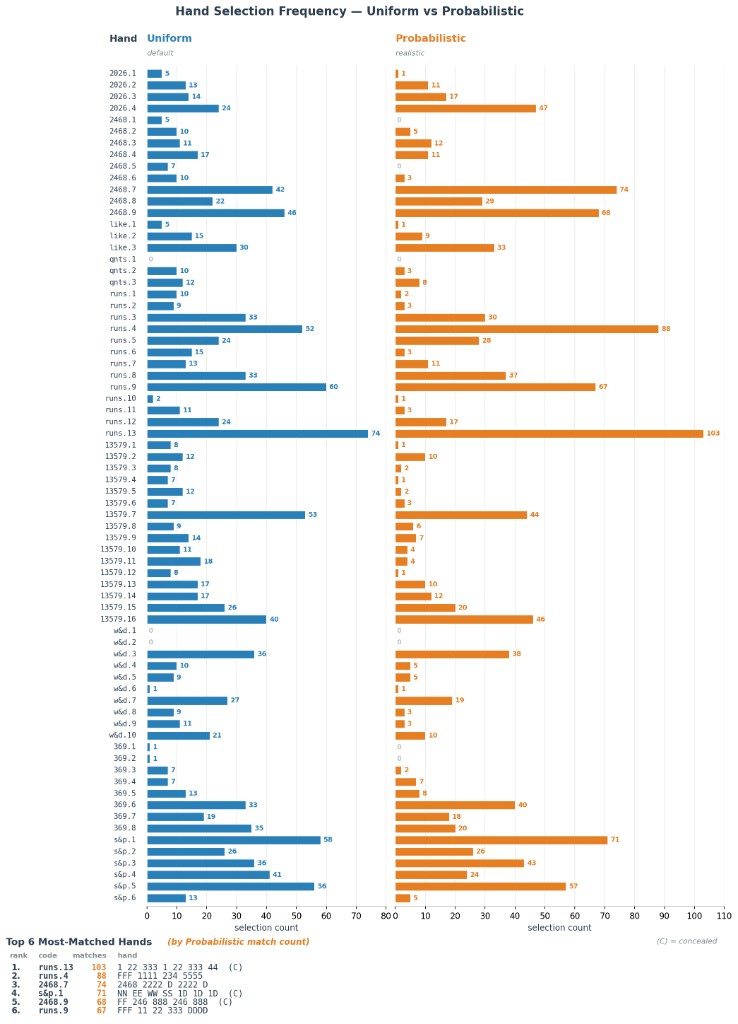
Note: A few hands — like Quints 1 and W&D 1 and 2 — show near-zero counts in both columns. They’re still perfectly playable and winnable; they just rarely come up as the top-matching hand in a random 14-tile deal because of how the tiles are composed.
Which should I use?
Most players keep the default Probabilistic Distribution on so practice matches the hand mix you'll actually see at a real table. If you're learning the year's card and want every section to get the same amount of practice, switch to Random Uniform Distribution instead.